
The specific way to brush when you have gum recession
I remember the exact Tuesday morning I realized I was literally scrubbing my smile away. I stood in front of the bathroom mirror, leaned in close, and saw it— a tiny, yellowish notch at the base of my canine tooth that hadn’t been there a year ago. It wasn’t a cavity. It was my root, exposed and vulnerable because I had spent decades treating my gums like I was scouring a cast-iron skillet. I thought I was being thorough, but I was actually sandpapering my mouth. If you have ever felt that sharp, icy zing when drinking cold water or noticed you are looking a bit ‘long in the tooth,’ you know the quiet panic that sets in. Today, I am going to show you how to pivot from ‘aggressive cleaner’ to ‘gentle protector’ so you can stop the damage before it turns into a surgical nightmare.
My Ah-ha Moment After Years of Brushing All Wrong
For years, I believed the lie that ‘firm’ meant ‘clean.’ I would buy the stiffest bristles I could find and go to town. That was my first big mistake. When you have gum recession, the game changes entirely because you are no longer just cleaning enamel; you are dealing with cementum, which is much softer and wears down easily. I had to learn how to tell if your gums are receding from brushing too hard before I could fix my technique. It turns out, according to the American Academy of Periodontology, nearly 50% of adults over age 30 suffer from some form of periodontal disease, and aggressive brushing is a massive contributor. I was part of that statistic, and I bet you might be too. Have you noticed your gum line creeping upward, or have you ever seen why your gums look pale instead of healthy pink? Let me know in the comments if you’ve seen these changes in your own mirror.
Is it actually possible to fix receding gums with just a toothbrush?
Let’s be realistic: you can’t ‘grow back’ gums that are already gone just by switching your brush, but you can absolutely stop the recession in its tracks and prevent the need for painful grafts. When I finally swallowed my pride and asked my dentist, she told me that my ‘meticulous’ habits were actually the culprit. I had to unlearn everything. I started using a saltwater rinse hack for occasional sensitivity and swapped to an ultra-soft brush. The goal today is to master the ‘Modified Bass Technique’—a fancy name for a simple, vibratory motion that cleans the pocket without shredding the tissue. It feels weird at first, like you aren’t doing enough, but your roots will thank you. We are going to dive into the specific angles and pressures that keep your smile intact without the ‘zing’ of sensitivity.
I once tried to brush my teeth while rushing for a 6 AM flight, and I was horizontal-scrubbing so hard I could practically hear the bristles screeching against my enamel. I thought I was being efficient; in reality, I was just fast-tracking my way to a dental chair. To stop the damage, you have to transition from a ‘scrubber’ to a ‘vibrator.’ The core of this is the Modified Bass Technique, which sounds like something you’d learn in a fishing class but is actually the gold standard for gum preservation. If you don’t get this right, you’ll eventually find yourself wondering why your teeth look gray instead of white as that protective enamel layer thins out from over-aggressive friction.
Master the Gentle Jiggle That Saves Your Smile
The biggest hurdle isn’t the brush itself—it’s your grip. I used to hold my toothbrush like a tennis racket, ready to serve an ace. Now, I use what I call the ‘Violin Grip.’ Hold the brush with only your fingertips. This naturally limits the amount of force you can apply. Think of it like this: you are trying to dust a delicate glass figurine, not power-wash a driveway. When I first made this shift, I felt like I wasn’t getting my teeth clean at all. I actually struggled with the reason your teeth feel fuzzy even after brushing for the first week because I was so used to the ‘squeaky’ feeling of stripped enamel. But after ten days, the inflammation in my gums subsided, and that angry red line started to fade into a healthy pink.
Angle Your Brush Like You Are Tucking in a Blanket
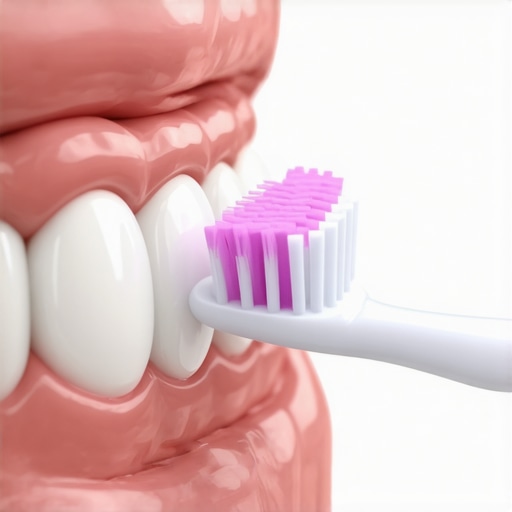
The 45-degree angle is non-negotiable. You aren’t aiming for the flat surface of the tooth; you are aiming for the ‘sulcus,’ that little pocket where the gum meets the tooth. Imagine you are trying to gently tuck a very thin silk blanket under the edge of a mattress—the mattress is your tooth, and the blanket is the gum tissue. You want the bristles to slide just slightly underneath the gum line. Once they are in place, don’t move the brush back and forth. Instead, use a tiny, circular vibratory motion. This shakes the plaque loose without sawing away at the soft cementum of your roots. I remember the first time I did this correctly under my dentist’s supervision; it didn’t hurt, and for the first time, I didn’t see pink in the sink when I spit.
Why Your Toothpaste Might Be Working Against You
While you are fixing your technique, you need to audit your tools. If you are using ‘whitening’ pastes that feel gritty, you are essentially using liquid sandpaper on your recession sites. I learned the hard way about the truth about charcoal toothpaste after a month of using it left my roots feeling like they were on fire every time I breathed in cold air. If your teeth are already sensitive, look for a paste with potassium nitrate and avoid anything with large abrasive particles. This is especially vital if you have restorative work, as you don’t want to find out why your porcelain veneers look opaque because you’ve scratched the finish off with a stiff brush and harsh paste.
Align Your Bite to Reduce Gum Stress
Sometimes the ‘how’ of your brushing isn’t the only problem; it’s the ‘where.’ If your teeth are crowded or tilted, they create ‘high-pressure zones’ where the gum is naturally thinner and more prone to snapping back under the slightest pressure. I’ve seen friends utilize invisalign for family dental care not just for the aesthetics, but to reposition teeth into a safer alignment that allows the gums to sit comfortably. When the bite is balanced, you don’t have to brush ‘harder’ to reach those awkward nooks. If the damage is already done and a tooth is structurally compromised, exploring why crowns are a game changer can help you understand how to protect the remaining tooth from further mechanical wear. The goal is a synergetic approach: better tools, better alignment, and most importantly, a much lighter hand.
While mastering the ‘Violin Grip’ is a great start, there is a nuance to gum preservation that even the most dedicated brushers miss. Most people assume that if they aren’t bleeding, they aren’t doing damage. But recession is a quiet thief. I’ve seen patients who switched to the best tools but still saw their gum line retreat because they were obsessed with ‘deep cleaning’ the wrong way. The biggest myth I encounter is the belief that high-pressure water flossers are a substitute for technique. In reality, if you aren’t careful, you can actually blast the gum tissue right off the tooth. Have you ever fallen into the trap of thinking ‘stronger is better’ with your dental gadgets? Let me know in the comments because I certainly used to think my water flosser needed to be on the highest setting to work.
Stop Blasting Your Gums Into Submission
Here is the contrarian truth: more power rarely equals more health. When you use a water flosser on the highest setting, you risk damaging the junctional epithelium—the ‘seal’ that keeps bacteria from sliding down your root. The Journal of Clinical Periodontology has highlighted that while oral irrigation is effective, excessive force can actually lead to localized trauma. This is likely why your gums throb after you use a water flosser for the first time; it’s a distress signal, not a sign of cleanliness. Think of your gums as a delicate gasket, not a rubber tire. You want to flush the debris, not pressure-wash the engine.
Why Crowded Teeth are a Magnet for Recession
We often think of orthodontics as a cosmetic pursuit, but for someone with receding gums, it’s a functional necessity. When teeth are crowded, they are often pushed ‘outside’ the protective envelope of the jawbone. This leaves the gum tissue incredibly thin and prone to snapping back like a tight rubber band. I’ve seen how invisalign for family dental care can act as a preventative shield by moving teeth back into the ‘bone housing’ where the gums have more support. Without proper alignment, you are fighting an uphill battle against physics every time you bite down. If you’ve noticed your teeth feel loose during the middle of invisalign treatment, don’t panic—it’s part of the biological remodeling required to create a safer, more sustainable gum environment.
Can you actually get a cavity underneath a porcelain crown?
This is the ‘Oops’ factor that catches almost everyone off guard. A crown is a shield, but it isn’t a suit of armor. The most common mistake I see is people neglecting the ‘margin’—that tiny line where the porcelain meets your natural tooth. If you don’t clean that area with the same vibratory technique we discussed, bacteria will seep under the edge. This is often why your gums are turning dark around the edge of a dental crown. It might not be a stain; it could be the shadow of a new cavity forming where you can’t see it. Understanding why crowns are a game changer requires realizing they need more maintenance, not less. You might even find why your crown feels like it has a high spot only when you grind because of how the gum inflammation is pushing the tooth slightly out of its socket. To truly win this game, you have to treat your dental work as a living part of your mouth, requiring the same gentle, precise care as your natural enamel.
I used to think that once I got a crown or finished an Invisalign treatment, I had ‘crossed the finish line.’ I figured the hard work was done and I could coast on autopilot. I was wrong. The reality is that maintenance is the longest and most important phase of your dental journey. If you don’t have a system, your expensive restorations will fail. I’ve shifted my focus from intense scrubbing to high-tech monitoring, and it has changed everything. By following family dentistry secrets maintaining oral health with modern techniques, I’ve managed to keep my gums stable for the first time in my adult life.
The One Tool I Refuse to Travel Without
If you are still using a manual brush, you are essentially trying to win a Formula 1 race in a horse-drawn carriage. I personally swear by electric toothbrushes with built-in pressure sensors. Why? Because as we’ve discussed, humans are terrible at judging force. My brush has a light that flashes red the second I press too hard. It’s the ultimate ego-check. This is particularly vital for anyone looking into the ultimate guide to crowns for a healthier smile, because protecting that porcelain-to-tooth margin is a delicate job. Even if you have physical challenges, finding the best toothbrush options for people with limited wrist mobility ensures that the technology does the work, not your muscles. I’ve found that the vibrating action of a sonic brush breaks up biofilm far more effectively than any manual circular motion I could ever master.
How can I keep my smile stable for the next decade?
Long-term success boils down to three things: chemical balance, physical protection, and regular professional oversight. For those of us with implants, the secret to making your dental implants last for the rest of your life is avoiding the ‘set it and forget it’ mentality. I also make sure to keep my aligners pristine; I learned how to keep your invisalign trays clear without buying expensive cleaners just by using simple, non-abrasive soaks. According to a study published in the International Journal of Prosthodontics, zirconia-based restorations have a five-year survival rate exceeding 98%, but that rate is entirely dependent on the biological health of the surrounding tissue. If you let plaque sit at the base of a crown, the ‘98%’ statistic doesn’t apply to you. I predict that in the next few years, invisalign innovations the future of family dentistry revealed will include even more AI-driven monitoring that tells you exactly when your gum health is dipping before you even see the redness. For now, my best advice is to try the ‘Two-Finger Rule’: hold your brush with just two fingers for an entire week. You’ll be shocked at how little pressure is actually required to get a perfect clean. Give it a shot tonight and see if that chronic sensitivity starts to fade.
The Hardest Lesson I Learned About Protecting My Gums
If there is one thing I’ve realized after years of trial and error, it’s that your mouth is an ecosystem, not a construction site. I used to think that “more effort” meant “better results,” but when it comes to receding gums, the opposite is usually true. Here are the three shifts in perspective that finally stopped my recession in its tracks. First, silence isn’t always safety; just because your gums aren’t bleeding doesn’t mean they aren’t retreating. I spent years ignoring the subtle yellowish notch at the gum line because I wasn’t seeing red in the sink. Second, technology is a tool, not a savior. You can buy the most expensive electric brush on the market, but if you still scrub like you’re cleaning grout, you’ll still do damage. Finally, alignment matters more than you think. I used to dismiss straightening as a vanity project until I realized that crowded teeth are essentially a trap for gum tissue. Looking into invisalign myths debunked helped me see that it’s a health-first decision.
My Non-Negotiable Kit for a Healthy Smile
I don’t believe in cluttering my bathroom cabinet with every gadget on the market. Instead, I stick to a few high-quality essentials that prioritize oral health without being abrasive. First, I always recommend a sonic toothbrush with a soft-head attachment; it’s the only way to ensure you’re getting that Modified Bass vibration right. Second, I’ve found that using the safest way to whiten sensitive teeth involves avoiding those generic, high-acid strips that can eat away at already exposed roots. If you are dealing with structural repairs, choosing the right crown expert is vital to ensure the fit doesn’t trap bacteria at the delicate gum margin. Finally, I rely on top oral health tips for your familys bright smiles to keep my entire household on a preventative schedule that stops emergencies before they start.
Take Control of Your Smile Before the Damage Becomes Permanent
The transition from “scrubber” to “protector” doesn’t happen overnight. It takes conscious effort to lighten your grip and trust that a gentle touch is actually doing the work. But I promise you, the first time you drink a glass of ice-cold water without flinching, you’ll know it was worth the effort. By incorporating family dentistry secrets maintaining oral health with modern techniques, you aren’t just cleaning your teeth; you are preserving your quality of life. Don’t wait until you need a surgical graft to change your habits. Start tonight with the two-finger rule and let your gums finally heal. Have you noticed a specific zing of sensitivity when you brush a certain tooth? Let me know in the comments below!