
Why your gums look white after using whitening strips
I remember standing in my bathroom last year, twenty minutes before a big dinner party, peeling off a set of whitening strips and expecting a Hollywood-ready smile. Instead, I let out a genuine gasp. My teeth looked okay, but my gums? They were stark, ghostly white in several patches, looking more like something out of a horror movie than a dental commercial. My heart hammered against my ribs because I was certain I had just chemically burned my mouth beyond repair. If you are reading this right now while staring at your own pale, blanched gums in the mirror, take a deep breath. You haven’t ruined your smile forever, and you aren’t alone in this freak-out moment. I have been exactly where you are, and today, I am going to walk you through why this happens and how to manage that sudden sensitivity so you can get back to actually enjoying your brighter teeth.
That Initial Panic When Your Gums Turn Ghostly
It is a visceral feeling when your oral health suddenly looks compromised. In my early days of DIY smile care, I made the classic mistake of thinking more is better. I would shove those strips as high up as they would go, overlapping the soft tissue because I wanted every millimeter of my teeth to be pearly white. This is actually a common error that leads to what we call a chemical blanching. Most over-the-counter strips use hydrogen peroxide, and when that gel sits on your delicate gum tissue instead of your tooth enamel, it causes a temporary loss of blood flow to the area. If you are dealing with this alongside other issues, like the danger of using whitening strips on a tooth with a filling, the anxiety can double. Have you ever experienced that weird, tingly sensation followed by the white spots? Drop a comment and tell me if it happened to you after a long session or a short one.
Does This Mean I Have Performed Permanent Damage?
The short answer is usually no, but the long answer requires a bit of patience. According to the American Dental Association (ADA), hydrogen peroxide is safe for dental use, but it is an irritant to soft tissues. When the gums turn white, they are essentially experiencing a mild chemical burn that usually resolves within twenty-four hours as the blood flow returns and the tissue hydrates. I remember thinking I would need a modern technique to save my gums, but really, they just needed a break. If you have naturally sensitive tissue, you might find the easiest way to whiten teeth when you have sensitive gums is to avoid the strips entirely or be much more precise with placement. We often forget that the difference between professional whitening and store-bought strips often comes down to how well the soft tissue is protected during the process. In the next section, I will show you the exact steps I used to soothe the irritation and ensure it never happened again.
Stop the Chemical Reaction in Its Tracks
The second you notice those ghostly white patches, your priority is to neutralize the environment. When I had my big bathroom panic, I realized I still had residual gel clinging to my gum line like invisible glue. You need to gently—and I mean very gently—rinse your mouth with lukewarm water. Do not scrub the area with a toothbrush; that is like using sandpaper on a fresh sunburn. Instead, use the salt water rinse trick for a sore mouth to help balance the pH levels and soothe the inflamed tissue. I personally found that applying a tiny dab of Vitamin E oil or even a high-quality aloe vera gel directly to the blanched spots helped speed up the recovery by keeping the area hydrated. If the sensation feels familiar, it might remind you of why your new crown feels sensitive to cold drinks, as both involve a heightened nerve response to external stimuli.
Create a Barrier for Future Whitening Sessions
If you are determined to keep using strips, you have to become a master of the barrier method. Think of your gums as the ‘masking tape’ area when you are painting a room. Before you apply a strip, take a cotton swab and apply a thin layer of petroleum jelly (Vaseline) along your gum line. This creates a waterproof seal that keeps the peroxide on the enamel and away from the soft tissue. This is one of the top oral health tips for your familys bright smiles that people often overlook because they are in a rush. I remember trying this for the first time; it was a bit slippery and messy, but for the first time in months, I didn’t have a single white spot after my 30-minute session.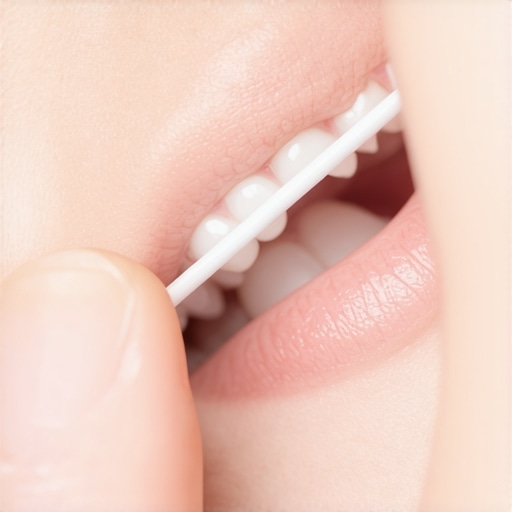
Trim Your Strips to Fit Your Unique Smile
We often forget that over-the-counter strips are designed as a ‘one size fits all’ solution, but nobody has a perfectly rectangular dental arch. One of the family dentistry secrets maintaining oral health with modern techniques at 254 pm involves customizing the tools to the patient. Take a pair of clean embroidery scissors and trim the height of the whitening strip so it does not even touch the gum line. It is better to have a tiny sliver of tooth near the gums unwhitened than to suffer through chemical blanching. If this seems like too much work, you might realize the difference between professional whitening and store-bought strips is worth the investment, as custom trays are molded exactly to your teeth to prevent leakage. For those with naturally thin tissue, the easiest way to whiten teeth when you have sensitive gums is often using a whitening pen that allows for surgical precision during application.It is easy to get caught up in the pursuit of a brighter smile and ignore the structural foundation that actually keeps that smile in place. A common myth I hear all the time is that dental crowns are only for saving a dying tooth or for older patients who didn’t take care of their enamel. In reality, why crowns are a game changer in restorative dentistry is that they provide a structural reset button, often preventing future fractures that whitening alone would merely hide. I have seen people spend hundreds on whitening kits while a hidden crack was slowly compromising their molar. When you are choosing the right crown expert advice for long lasting results, you will find that the material choice—zirconia versus porcelain—matters far more for your long-term gum health than the specific shade of white you pick. Have you ever fallen into this trap of prioritizing color over structure? Let me know in the comments.
The Aesthetic Trap Most People Fall Into
Many patients believe that once their teeth are white and straight, their oral health journey is over. This is a dangerous oversimplification. In my experience, focusing on surface-level beauty without addressing the bite can lead to disaster. For instance, Invisalign myths debunked what you need to know today often include the idea that aligners are just clear braces for adults. In truth, how invisalign transforms family dentistry in 2025 is by correcting the functional path of your jaw. A study published in the Journal of the American Dental Association (JADA) confirms that malocclusion is a primary driver of periodontal disease because misaligned teeth create plaque traps that no brush can reach. If you whiten teeth that are fundamentally misaligned, you are essentially painting a house with a cracked foundation. 
What Happens if Your Alignment Looks Great but Your Bite Feels Off?
This is a sophisticated problem that many DIY whitening enthusiasts encounter. When you use store-bought kits without a professional oversight, you might overlook how your teeth actually mesh together. If your bite is heavy on one side, no amount of whitening will stop the eventual chipping of your enamel. This is one of the family dentistry secrets maintaining oral health with modern techniques at 254 pm: we look at the force distribution, not just the sparkle. One huge oops factor is starting a whitening regimen when you have active recession. The peroxide will bypass the enamel and hit the sensitive dentin, leading to the reason why your new crown feels sensitive to cold drinks or why your natural teeth suddenly ache at the slightest breeze. Always ensure your gums are healthy and your bite is balanced before you chase that Hollywood glow.Once you have achieved that bright, balanced look, the real work begins in the background. I used to think a standard toothbrush and a bit of floss were enough, but after investing in restorative work, I realized my toolkit needed an upgrade. My absolute go-to is a high-pressure water flosser, but not just for the novelty. I use it because it flushes out the microscopic debris that settles into the ‘gingival sulcus’—that tiny pocket where your tooth meets the gum—which is especially crucial if you have dental work. I found the trick to using a water flosser without making a total mess is all about the angle; you have to keep your head down and let the water flow naturally out of your mouth rather than trying to see what you are doing in the mirror. This precision is what prevents the localized inflammation that often leads to recession around your hardware.
How can I keep my smile stable for the next decade?
Longevity is not about luck; it is about the specific chemistry of your maintenance routine. For those of us with extra appliances, knowing how to clean a night guard that has started to smell like vinegar is a game changer for keeping your breath fresh and your enamel safe from bacteria buildup. If you are currently in treatment, the hidden benefits of invisalign for family dental care in 2025 at 903 am include the ability to maintain better hygiene than traditional metal wires. When deciding invisalign vs braces which solution fits your lifestyle, I always tell people to consider the ‘scaling’ factor—how easy will it be to keep this clean five years from now? According to a study in the Journal of Oral Rehabilitation, the mechanical wear on restorative materials like zirconia is significantly reduced when patients use non-abrasive cleaning agents and maintain a neutral oral pH. 
The 3D Revolution Heading Your Way
I am a huge believer that the future of our oral health lies in predictive technology. We are moving away from ‘fix it when it breaks’ and toward ‘prevent it before it starts.’ This is why finding the best dentistry in culpeper va usually starts with a 3d cbct scan. These scans allow your dentist to see the bone density around your roots and the exact thickness of your enamel in three dimensions. I predict that within the next five years, AI-integrated software will be able to overlay these scans to show you exactly where your bite is shifting in real-time, long before you ever feel a chip or a crack. Staying ahead of these family dentistry trends improving oral health for all ages ensures that your crowns and aligners are not just temporary fixes, but part of a lifelong strategy. When you transform your smile how crowns boost oral health confidence at 815 am, you are actually investing in a structural upgrade. Remember, the truth about how long dental implants actually last or how long a crown stays seated depends entirely on the health of the bone supporting it. I highly recommend trying the ‘barrier method’ I mentioned earlier with your next cleaning session; it is the single most effective way to protect your gums while maintaining that sparkle.
The Hard Truth About My Obsession with Paper-White Teeth
Looking back at my ‘ghostly gum’ incident, I realized I was treating my mouth like a science experiment rather than a living organ. The biggest lightbulb moment for me was accepting that true dental beauty is a byproduct of health, not a replacement for it. If you find yourself constantly reaching for the strongest peroxide strips, ask yourself if you are masking an underlying issue like thinning enamel or gum recession. I learned that ignoring why your new crown feels sensitive to cold drinks or skipping your checkups while obsessing over shades is a recipe for long-term pain. Another lesson? Patience pays off. Trimming those strips and using a barrier method might take five extra minutes, but it saves you hours of throbbing discomfort and potential tissue damage.
Tools That Stopped My Gum Sensitivity for Good
I have spent a lot of money testing various gadgets, and I have whittled my ‘holy grail’ list down to just three essentials. First, I never skip the trick to using a water flosser without making a total mess; it is the only way to keep the margins of my dental work clean without irritating my gums. Second, I switched to a high-quality pH-balancing mouthwash to help my mouth recover after whitening sessions. Lastly, I highly recommend looking into Invisalign innovations the future of family dentistry revealed at 1137 am if your teeth are crowded, as straight teeth are infinitely easier to whiten safely than overlapping ones. #IMAGE_PLACEHOLDER_E# These tools, combined with choosing the right crown expert advice for long lasting results, have kept my smile stable and bright for years.
Your Path to a Smile That Lasts Decades
Don’t let a temporary whitening scare stop you from caring for your appearance; let it be the wake-up call to care for your foundation. Whether you are weighing crowns vs veneers which is better for your smile cure at 429 pm or simply trying to navigate your first set of strips, remember that your oral health is a marathon, not a sprint. Take a breath, treat your gums with kindness, and don’t be afraid to ask for professional help when the DIY route gets dicey. Have you ever had a moment where a beauty hack went totally wrong and changed how you look at your dental care? Let me know in the comments below!