
The hidden reason your gums bleed even if you floss daily
I stood there, staring at the porcelain sink, wondering if I’d accidentally brushed with a wire brush instead of a soft-bristle one. There it was again—that annoying pink tint in the water. I had flossed. I had brushed. I’d even used that fancy mouthwash that’s supposed to kill 99.9% of germs. It felt like a betrayal. If you’ve ever felt like your mouth is gaslighting you, you aren’t alone. We’re taught that flossing is the ultimate shield against gum disease, but sometimes the shield has cracks we don’t even know exist. Today, we are going to figure out why your gums are still protesting and how to finally get that clean, blood-free rinse you’ve been working for.
Your sink shouldn’t look like a horror movie
The biggest mistake I made for years was thinking that bleeding was just part of the process. I’d tell myself, ‘Oh, I must have just missed a day,’ or ‘Maybe I’m just getting the deep-down dirt out.’ That was a lie. Bleeding is an inflammatory response, and it usually means something is happening below the surface that your floss just can’t reach. For a long time, I didn’t realize I was missing the hidden spots most people miss while brushing their teeth, which allowed bacteria to set up camp right under my gums. Have you ever noticed your gums getting sensitive right after you think you’ve been extra diligent with your routine?
Is flossing actually worth the hype?
It’s a fair question to ask when you aren’t seeing the results you want. You might even start wondering why your gums are receding despite brushing twice a day and doing everything ‘right.’ The reality is that flossing is essential, but it isn’t a magic wand if your technique is off or if there are underlying issues like Vitamin C deficiency or hormonal shifts. According to the American Academy of Periodontology, nearly half of American adults suffer from some form of gum disease, proving that our standard routines might need a serious upgrade. I’ve found that incorporating top oral health tips for your familys bright smiles means looking at more than just the string; it’s about the environment in your mouth as a whole. Let’s get into the nitty-gritty of what’s actually happening when you see red.
Angle your brush for a deeper clean
Most of us scrub our teeth like we’re cleaning a patio with a heavy-duty pressure washer. It’s simply too much force for delicate tissue. I learned this the hard way when I realized the reason your gums bleed only when you use a firm toothbrush is that you’re essentially sandpapering your own mouth. Instead of a back-and-forth sawing motion, you need to angle your brush at a 45-degree angle toward the gum line. Think of it like gently sweeping dust out from under a baseboard rather than just hitting the wall. This specific angle allows the bristles to slide just a millimeter or two under the edge of the gum, which is the primary site where plaque hardens into tartar. If you find manual brushing too aggressive or you’re a naturally ‘heavy-handed’ brusher, switching to the safest way to use an electric toothbrush on sensitive teeth can take the guesswork out of the pressure. Most modern brushes will actually buzz or light up if you’re pressing too hard, which is a life-saver for your enamel. 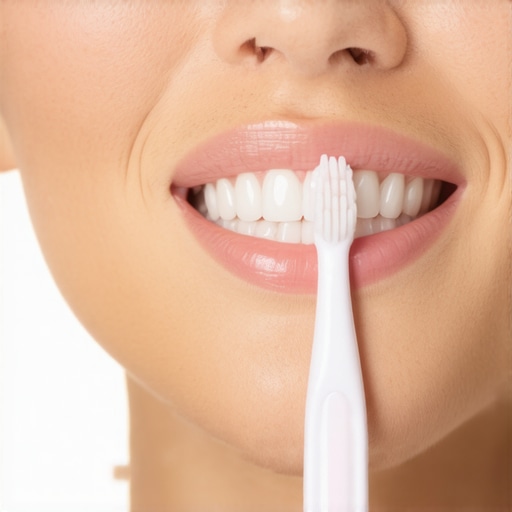
Ditch the string if it isn’t working
If traditional flossing feels like a total chore or you have tight teeth that shred the thread into a million tiny fibers, stop forcing a method that makes you want to quit. I used to get so frustrated with my floss snapping halfway through that I’d just give up for weeks, which only made the bleeding worse when I finally tried again. Then I discovered the trick to using a water flosser without making a total mess, and it changed the entire game. By using a pulsating stream of water, you can flush out those deep periodontal pockets where gingivitis takes root. It’s especially helpful if you’re dealing with crowded teeth where physical floss just can’t navigate the tight corners.
Stop crowding before it ruins your gums
Sometimes, the reason you can’t get your mouth truly clean isn’t due to a lack of effort—it’s the actual architecture of your mouth. When teeth are overlapped or rotated, they create ‘biofilm bunkers’ that no brush or floss can penetrate effectively. This is where modern orthodontic solutions become a health necessity rather than a cosmetic luxury. Many people think clear aligners are just for a straight smile, but invisalign myths debunked what you need to know today shows that straightening your teeth is actually a functional requirement for long-term gum health. When your teeth are properly aligned, the ‘natural’ cleaning process of your saliva and tongue can actually reach the tooth surfaces, and your brush can do its job without hitting obstacles.
Be gentle with your restorations
If you have existing dental work, the rules of engagement change. You can’t just yank floss through a bridge or a crown like you would with natural teeth. I remember the sheer panic I felt thinking I’d popped a temporary cap off during my morning routine because I pulled upward too hard. Knowing how to floss around a temporary crown without pulling it off is a survival skill for your smile. For those with permanent work, the ultimate guide to crowns for a healthier smile suggests using specialized tools like interdental brushes or super-floss to keep the margins clean. Bacteria love to hide at the ‘seam’ where the crown meets your natural tooth, so extra precision here is non-negotiable.
Reset your mouth’s environment
Sometimes you need a biological reset when your gums are in a state of high alert. If things feel inflamed and tender right now, don’t just keep poking at the sore spots with a toothbrush. Use the salt water rinse trick for a sore mouth. This isn’t just an old wives’ tale; the salt creates an osmotic effect that draws out excess fluid from inflamed tissues and reduces swelling. It creates a temporary environment where harmful bacteria struggle to thrive, giving your body a fighting chance to heal the micro-tears in your gums. High-quality oral care isn’t about expensive gadgets; it’s about the consistency of these small, deliberate actions that respect the biology of your mouth.
The myth of the invincible crown
Respecting the biology of your mouth means understanding that even our strongest repairs have limits. Most people treat a new crown like a gold medal—something to be won and then forgotten. However, that is a dangerous mistake. In my experience, a crown actually demands more vigilance than a natural tooth. While the ceramic or porcelain itself won’t decay, the ‘margin’ where the crown meets your natural tooth is the most vulnerable square millimeter in your entire mouth. If your hygiene slips, bacteria won’t attack the crown; they will attack the tiny seam where it connects to your root. This is why choosing the right crown expert advice for long-lasting results is about more than just finding a dentist who can drill; it is about finding an artist who can seal that gap with microscopic precision. If there is even a hair-width gap, you have created a permanent home for plaque that no floss can reach. 
Why does my crown feel weirdly tall in the morning?
I hear this question constantly from patients who feel like their bite has shifted overnight. It is a nuanced issue that often points to how your body reacts to nocturnal stress. You might find that the specific reason your crown feels tall when you wake up is actually related to the periodontal ligament. When you clench your teeth at night, these ligaments become slightly inflamed, pushing the tooth up just a fraction of a millimeter. It is rarely a failure of the crown itself, but rather a signal that your jaw is under excessive pressure. Recognizing these subtle biological signals is what separates a basic routine from true oral expertise.
Beware the clear aligner acid trap
Everyone says Invisalign is the easy way to a better smile, but there is a major ‘oops’ factor that beginners often overlook. The real trap isn’t the discomfort; it’s the environment you create inside the tray. If you pop your aligners back in after a quick snack without a thorough rinse, you are essentially creating an ‘acid bath’ for your enamel. Because the tray seals against your teeth, your saliva—which is your mouth’s natural defense—cannot reach the tooth surface to neutralize the pH. This is one of the most critical invisalign myths debunked what you need to know today: clear aligners require a higher level of discipline than traditional braces to avoid ‘aligner breath’ and accelerated decay. Have you ever fallen into the trap of thinking a dental procedure was just for looks, only to find out it was a health necessity?
Demand digital precision for your family
If your dentist is still using that goopy, gag-inducing putty to take impressions, you are living in the past. To truly unlock why crowns are a game-changer in restorative dentistry, you need the precision of a 3D scan. A study published in the Journal of Dentistry found that digital impressions significantly reduce the ‘marginal gap’ compared to traditional methods, meaning your restoration fits better and lasts significantly longer. We are seeing family dentistry trends improving oral health for all ages move toward this technology because it removes human error from the equation and allows for biomimetic restorations that mimic your natural wear patterns. Let me know in the comments if you’ve noticed a difference in your dental work since switching to a tech-forward clinic!
Moving past the basics of brushing requires a bit of a gear shift. I’ve realized that the tools I used in my twenties just don’t cut it now that I have a mix of natural teeth and high-end restorations. One of the most significant shifts in my routine was ditching the ‘one-size-fits-all’ approach to cleaning between teeth. While string floss has its place, many experts now point toward interproximal brushes as the gold standard for anyone with crowns or wider gaps. A study in the International Journal of Environmental Research and Public Health highlights that interdental brushes are significantly more effective at removing plaque from proximal surfaces compared to traditional floss. I personally use these tiny brushes to sweep around the base of my dental work where my standard brush misses.
How do I maintain my smile’s alignment for the next decade?
The hard truth about orthodontic work is that your teeth have a memory, and they desperately want to return to their old, crowded positions. If you’ve finished treatment, how invisalign transforms family dentistry in 2025 emphasizes that retention is a lifetime commitment, not a six-month phase. I make it a point to use specialized cleaners because the best way to travel with aligner cleaners in your carry on ensures my retainers don’t become a breeding ground for bacteria while I’m on the road. 
Trust the data over your intuition
We are entering an era where invisalign innovations the future of family dentistry revealed at 1137 am are making it possible to track tooth movement and wear in real-time. I predict that within five years, we will all have AI-integrated apps that analyze a simple smartphone photo to alert us to receding gums before they even start to bleed. This proactive approach is exactly what family dentistry secrets maintaining oral health with modern techniques at 254 pm is all about—stopping the damage before it requires a drill. When you are looking to transform your smile how crowns boost oral health confidence at 815 am, remember that the work in the chair is only 20% of the battle; the rest is your daily maintenance kit.
Upgrade your interdental game today
My specific recommendation is to stop viewing your water flosser or electric brush as an optional luxury. These are the defensive players in your oral health league. If you haven’t yet, try using an interdental brush tonight after your regular routine; you might be shocked at what your ‘perfect’ brushing habit left behind. Staying ahead of the curve means utilizing family dentistry trends improving oral health for all ages to keep your natural teeth and your restorations in peak condition for the long haul.
The Hardest Lesson I Learned About Saving My Smile
For years, I believed that dental work was a ‘one and done’ fix. The reality is that choosing the right crown expert advice for long-lasting results taught me that the margin between success and failure is thinner than a piece of hair. I also realized that bleeding isn’t an ‘aggressive cleaning’ badge of honor—it’s a cry for help from your tissues. Finally, I learned that technology like 3D scanning isn’t just a luxury; it’s the only way to ensure your bite doesn’t slowly destroy your investment over time.
The Gear That Actually Makes a Difference
If you are serious about changing your oral health trajectory, I recommend starting with three specific things. First, pick up an interdental brush for those tight spaces where traditional floss often fails. Second, dive into family dentistry secrets maintaining oral health with modern techniques at 254 pm to understand how preventive care has evolved beyond just scraping teeth. Lastly, if alignment is the root of your hygiene struggles, compare invisalign vs braces which solution fits your lifestyle to see which tool will help you clean your teeth more effectively in the long run.
Taking the First Step Toward a Blood-Free Morning
Improving your oral health isn’t about achieving perfection overnight; it’s about being more intentional with the minutes you spend at the sink. Whether you are dealing with sensitive gums or trying to figure out why your teeth feel sticky even after you just brushed, remember that every small adjustment adds up. Modern family dentistry provides us with incredible tools to keep our smiles for a lifetime, but the daily consistency has to come from you. Have you ever switched from traditional string floss to a water flosser or interdental brushes? Let me know how it changed your routine in the comments below!